
 España

Forged Steel Globe Valve
| Size | 3/8"~2-1/2" |
| Rating | 800LB,150LB~2500LB |
| Body Materials | Carbon Steel, Stainless Steel, Alloy Steel, Duplex S.S. XDSS, etc. |
| Design Standards | API 602/ASME B16.34 |
| Trim | 13Cr, Stainless Steel |
| Face to Face Standards | ASME B16.10 |
| Flange Dimension Standards | ASME B 16.5 |
| Pressure Test Standards | API598 |
| Quality/Product Certifications | ISO9001, ISO14001, ISO18001 |
| Fugitive Emissions | ISO 15848-1, API 622 |
| NACE | NACE MR 0103 NACE MR 0175 |
| Shutoff Class | API 598 (Zero Leakage), API 6D |
| End Connection | RF, RTJ, NPT, SW |
| Operation | Handwheel, Motor |
| NO. | PAPT NAME | MATERIAL-ASTM | 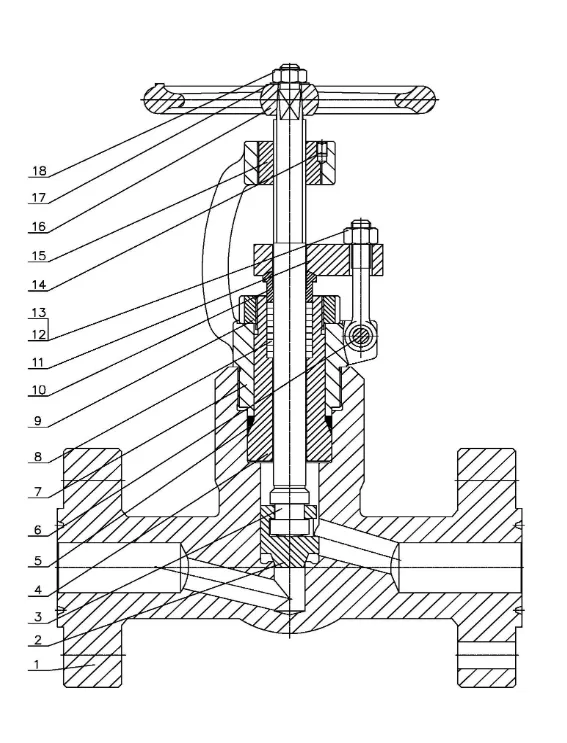 |
| 1 | BODY | ASTM A105 STL | |
| 2 | DISC | ASTM A182 F6A STL | |
| 3 | STEM | ASTM A182 F6A | |
| 4 | PRESSUER SEAL SEAT | ASTM A182 F6A | |
| 5 | GASKET | SS304 GRAPHITE | |
| 6 | PIN | ASTM A276 410 | |
| 7 | BONNET | ASTM A105 | |
| 8 | PACKING | GRAPHITE | |
| 9 | NUT | C.S. | |
| 10 | PACKING GLAND | ASTM A182 F6A | |
| 11 | GLAND FLANGE | ASTM A105 | |
| 12 | EYEBOLT | ASTM A193 B7 | |
| 13 | NUT | ASTM A194 2H | |
| 14 | SCREW | C.S. | |
| 15 | STEM NUT | ASTM A276 410 | |
| 16 | HAND WHEEL | A197 | |
| 17 | NAME PLATE | SS304 | |
| 18 | NUT | C.S. |
Warning
1. Remove end caps only when ready for installation.
2. Inspect both ports for obstructions or foreign material.
Clean if necessary.
3. If valves are shipped with gland flange nuts loose, tighten the nuts before putting the valves in service.
4. Position the valve into the pipe or the flange connection; ensure that any stress caused by improper pipe alignment is relieved first. Valves are not intended to be a means of aligning improperly fitted pipe.
5. Install the valve using qualified piping standards and practices. Valves marked with flow direction must be installed in line with the piping flow.
6. The recommended orientation for API 602 Forged Steel Globe Valves is upright with the valve in a horizontal line with the hand wheel positioned vertically above the valve centerline.
Flange Ends
- Select the proper gasket (including ring gasket) to install, line up the bolt holes between the valve flange and pipeline flange, then install the bolts and nuts and tighten to the accepted piping and bolting standards. The bolt threads should be lubricated first for ease of bolting.
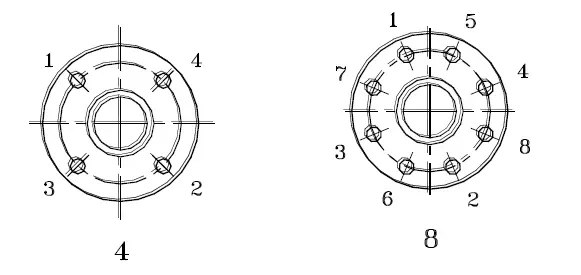
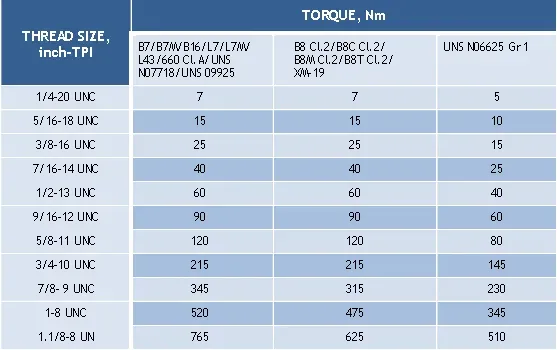
- Use an appropriate sized torque wrench when tightening the bolt/nut, to avoid flange deformation. Please follow below Figure and Table for bolting sequence and bolting torque. If the bolting quantity is different from the chart shown, please follow the same principle to get a new sequence to follow.
- For large diameter valves, the valve must be properly and safely supported during installation. After installation is completed, valve supports should be moved to the bottom of the valve flanges.
- After valve installation is complete, recheck and tighten the bolts including the gland bolts as necessary to the values provided in below Table.
- It is recommended that the tightness of the joint bolt tension and gland bolts be inspected at least yearly. Refer to below Table.
- l Check the threads on both the valve and the mating pipe for thread form and cleanliness. Check for any indication of an impact that might have deformed the thread either out-of-round or by a local indentation. Ensure no chips or grit is present.
- Threaded pipe joints depend on a good fit between the external and internal pipe threads for tight sealing. Apply an appropriate thread tape or thread compound to the external pipe threads except when dry seal threading is specified. Avoid getting the thread tape or thread compound into the internal flow area.
- The valves provided with socket-welding ends preparation are as per standard ASME B16.11 or as per customer requirements. Please refer to the general assembly drawings for the exact socket-welding ends dimensions.
- When welding socket weld end valves, be sure to leave 1.6 mm gap between end of pipe and bottom of valve socket.
- The valves provided with socket-welding ends preparation are as per standard ASME B16.25 or as per customer requirements. Weld ends must be kept clean with no burrs, oil, dirt or foreign objects.
- The valve end and pipe end must be in proper alignment for effective welding.
- Follow the approved WPS to perform the welding. During welding, insure the temperature near the seat area does not overheat which will cause sealing area distortion. Protect the valve bore to prevent welding slag and foreign matter from entering the valve.
- After welding, use approved and proper Non-Destructive Testing (NDT) method to check the welds: clean the welds thoroughly, and then perform local heat treatment if required.
- When installation is complete, and prior to system testing and start-up, clean the valve by flushing the line of debris and other materials that may have accumulated inside the valve and in the valve seating area and surfaces during construction. When flushing the valve, open the valve fully, flush for a determined time based on line size. Close the valve and allow fluid.to fill the line, while opening and closing the valve while flushing. Fully close the valve, if seat leakage is noted after flushing, repeat flushing procedure. If leakage from the seat is still evident, the seating surface may be damaged and need repair.


